


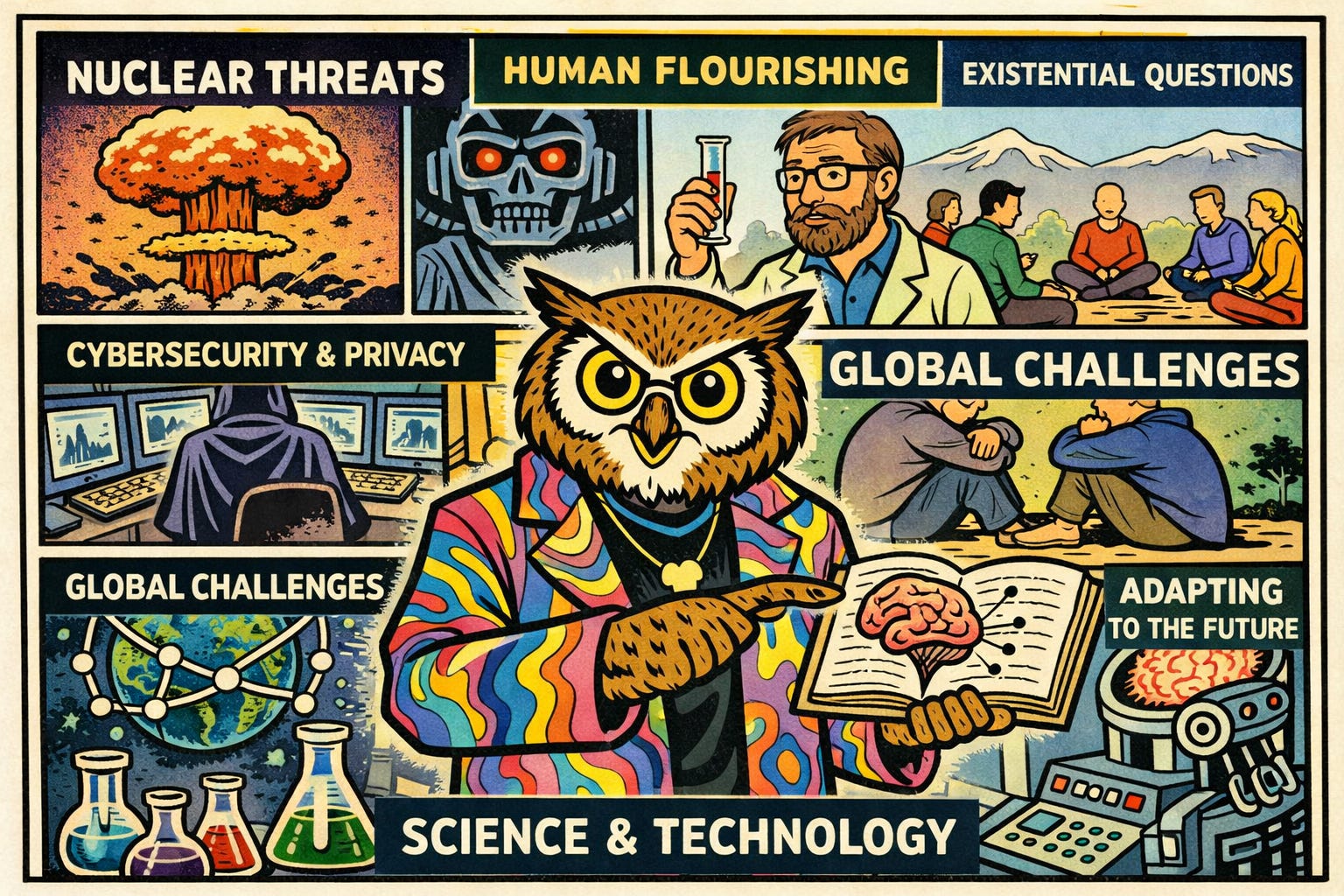
*note: some of CG’s points are emphasized or [summarized/clarified] to serve the reader, while preserving the flow and intent of the conversation. -Subheaders- have been inserted to signal new topics. The interviewer (LCM) is denoted with italics.
-The Path to Sensoria-
LCM: What brought you to the Sensoria concept? What were your motivations, and what was your path to this conclusion?
CG: Coming to the conclusion was a process of trying to understand what the greatest existential risks of the 21st century are. The agreement amongst most x-risk researchers seemed to be that there are a few major existential risks that humanity faces this century: meteor, supervolcano, super virus, etc.
The number that a lot of people throw around is about 10,000.
An existential risk is something that reduces the population to about 10,000 people, or reduces the population to a larger number but in such a state of hardship that technological progress can’t be maintained or progressed. A pandemic is rather unlikely to do that. Regardless of the virus, some people will always be immune just because of the sheer variability of the immune system. And given a global pandemic, people will quarantine before it ever gets to them. You can maintain notable amounts of the population through forced quarantine for a certain period of time.
So the biggest X-risk is most likely the use of technology irresponsibly. Most notably, nuclear war.
To make things worse, there’s also a strong pattern of power multiplication in the modern century. New technologies allow extremely few—fewer than ever before—to have global negative impacts.
[Many] consider certain dystopian scenarios to be significant existential risks. So it’s not just if we all die, but also if we all get taken over and/or our lives are dictated by an evil AI, or a dictator who has unlimited power of surveillance and control
—we might as well be dead.
-Black Sheep Syndrome-
The biggest mediating factor in people not using technology to destroy the planet is essentially mental health.
The problem I foresee in terms of the use of technology against humans and against the planet is people who suffer from black sheep syndrome. Essentially, they don’t feel connected to any other human, they’re unable to create relationships that mean anything to them, and therefore don’t ever develop appreciation of other humans and the human endeavor. An extreme case of misanthropic thinking.
This could potentially lead to someone wanting to destroy the planet or feeling betrayed by humanity as a whole. There have surely been people like this in the past, but fortunately they were never sophisticated or determined enough to have significant global impact. There have been cases of people attempting to engineer viruses and attempting to build other such things—they’ve been caught and apprehended and psychologically analyzed.
It doesn’t seem that this potentiality is decreasing in the future, and right now we don’t really understand the mechanisms behind why people might arrive at this kind of disposition.
I think that the convergence of mental health, consciousness research, and neuroscience research is necessary to understand and prevent these kinds of scenarios. Obviously, if we see in a child sociopathy or other traits that might lead to an individual with such problems, it could potentially be engineered out of them if we understand the mechanisms that lead to these things.
LCM: Or you could do targeted forms of socialization or intervention early on to reinforce capacities they are less likely to develop on their own.
CG: Looking at the state of mental health research, particularly mechanisms-oriented research around [these kinds of catastrophic trajectories], our state of understanding, our state of science in that area, was fairly disappointing.
-The Neuropharmacological Breakthrough-
Around the time of that conclusion, I came across Tom Ray at a psychedelic research conference, Breaking Convention. He had presented on his recent paper, “The Breadth and Depth of Consciousness,” where he takes a granular approach to understanding neurophenomenology—particularly the phenomena produced by activity at single neural receptor sites.
This was a notable progression of the field and introduced a research methodology that seemed able to perform a mapping or characterization of receptor mechanism-to-phenomenology through selective receptor interaction.
When I read this paper, I realized there would be a need for a very large-scale approach to doing this mapping, as we would need to understand at a population level how consistent these relationships are between certain receptors and certain phenomena, and what kind of variation in the population that neural architecture takes.
Producing this scale of data within traditional clinical trials and academia would be very slow, very expensive, and also may give a skewed perspective on this mapping because it frequently doesn’t reflect real-world data because of the artificial settings the data is collected in.
-The Community Incentive Model-
I realized that the incentive mechanism for contributing this data had to change. One of the best incentive mechanisms for people is community. If a community you’re part of or that you like is doing something and believes in something, you’re much more likely to participate in it.
That’s the origin of where Sensoria came from: How does one host an event in which people want to contribute phenomenology data in a serious and robust fashion?
LCM: Furthermore, if you want something to be a large-scale community incentive, it has to be something that’s acknowledged and destigmatized within the community…
How would you describe the context in which consciousness exploration occurs nowadays, and why is that a problem?
CG: The general public sees the activity that happens at parties or festivals as debaucherous. Even retreats are often viewed askance. Exploring altered states generally is still taboo in a lot of the population.
Making neurophenomenology trendy is a challenge enough, but changing the stigma associated with psychoactives, or other modalities to reach altered states—this perspective has to change.
LCM:And I think it can be done in a way that doesn’t necessarily emphasize the need for psychoactive substances. Technodelics, meditation, psychedelics, they’re really just instances of state engineering [or exploration!].
CG: And these things can serve as a [positive] Trojan horse for potentially more psychoactive research: as people start to understand the scope of what is being studied, they will understand the importance of studying it from all angles, including the utility of psychoactive substances.
Part of the destigmatization effort is to situate [altered states] within a larger mission that is consistent with people’s values. People want to avoid existential risk, but it isn’t obvious at first pass why that means we should encourage state exploration.
-Social Cohesion as Existential Risk Mitigation-
A common subject we bring up is social cohesion. That’s why one of the focus points of Sensoria is to understand the mechanisms of entactogens and other tools that can be used to catalyze community creation.
Because the existential risk here is primarily based around individuals who can’t form social relationships. It is most important to start there and understand how we can provide these individuals the capabilities of creating these relationships, because those will ultimately be the thing that stops them from trying to make large-scale negative impact on the planet.
LCM: Does this speak to some contemporary post-industrial alienation from rituals that have long been part of human patrimony?
CG: Potentially. I think it’s something we already have but have never been able to study with such granularity. And it also has never been that important, because generally the worst-case scenario before the modern age was that someone would kill someone in the tribe or in the city, or someone would become homicidal—which, terrible as it is, is not the same as existential risk.
The magnification of agency posed by contemporary technology makes the need for social cohesive rituals of much higher gravity.
LCM: So it’s not just a destigmatization problem. It’s a scaling problem. These need to be things that are publicly available and available in a pluralistic fashion.
-Ontological Pluralism and Meta-norms-
LCM: Could you comment on the role that ontological pluralism takes within our framework?
Ontological pluralism is a core objective of the research we do with Sensoria, because humans are inherently varied—not only biologically, but ideologically. A lot of these ideologies can seem conflicting to the ideologies that other people hold.
So we must develop certain metanorms or metabeliefs that have to be shared between communities and between people. The [arguably most important] one is ontological pluralism. With few caveats, people should be able to believe and take action around generally whatever they want that doesn’t harm people.
These meta-norms need to be developed so that we can build the parameters of acceptable belief systems within cultures on the planet. Generally, this hasn’t been too much of a problem, because if two tribes or cities or states disagree, they might war, but ultimately there’s no existential risk that comes from this. But unfortunately now, with the [force multiplying] technology we have, we may have to engender this ontological pluralism in order to prevent more violence or negative global impact from differing belief systems.
The Fractal Paradox
LCM:How does this relate to the concept you’ve coined, the fractal paradox?
My use of the term fractal paradox is generally just representative of this idea that the universe or the world is inherently built on paradoxical parameters, that belief systems are models and never reflect the truth of the universe, and that the human experience itself is inherently paradoxical.
You cannot capture the paradoxical nature by definition by deploying a single model, because a model has to be internally consistent. So the only model that kind of makes sense is a meta-model incorporating all conflicting beliefs—which is also denying all conflicting beliefs.
[The term] is generally used in jest to represent this idea that any absolute confidence is ridiculous, and that understanding Truth with a capital T will forever be impossible, but that the pursuit of it is always noble.
Even though it is paradoxical, our purpose is to pursue this paradox and try to understand it, even though we know we will never understand it. And theoretically, the only way to understand it is to have all beliefs and to disbelieve all beliefs simultaneously. In practice, it’s somewhat impossible, but it’s healthy to get in the practice of entertaining [and denying] multiple belief systems.
LCM: Practically, we all have to have certain belief systems to navigate the world. But the important part is to always remember that those belief systems are built on flawed models, and that they can only help you get as far as they are useful, but that they are never perfect.
Ontological pluralism in practice connotes the development of meta-norms—the notion that you can propose rules that govern how people who represent or embody multiple different models are to behave among one another, based on the presupposition that no model supersedes another.
-Neurosociology: A New Field-
LCM: Could you talk about the concept of neurosociology as a potential neo-field?
CG:The way I think about neurosociology is: we are coming to a time where subpopulations will often explore areas of the state space consistently and therefore change their belief systems, change their relational methodologies and general behaviors due to the consistent explorations of a certain part of the state space.
The study of the trait changes that come from these explorations can generally be seen as neurosociology: How societies and culture and populations change depending on the states/traits that the constituents of them experience.
LCM: Neurosociology could be thought of as the frameworks we’ve been developing around state and trait engineering, but applied at a multi-scale level. Group states can engender group-level trait changes—both through the group having radical changes as a result of a group state shift, and through emergent effects in a group of trait changes arising from individual state engineering.
CG: Cultures can shift as a result of entheogenic practices. That’s part of their main purpose. It’s something that’s never been formally studied, certainly not from a dynamical systems perspective.
There are lots of interesting insights that can be gleaned from subpopulations. For example, there’s a subpopulation of Mormons in Utah that are notorious for making one exception to the church’s condemnation of psychoactive substances, and that is for MDMA. That would be a really interesting community to study.
This applies to pretty much any group of people that does psychoactive substances with some kind of consistency, especially in group formats—meditators, ayahuasca communities, even contemporary Jewish/Christian/Muslim orthodoxy.
-State Engineering for Everyday Life-
LCM: Is there anything else pertinent to the core worldview or founding impetus?
CG: Maybe the only other thing is just that what we generally perceive as our sober resting state might not be the most conducive state for most of the outputs we would like in our life.
A big motivation for Sensoria was to produce a map of the mind—the neurophenomenological state space—in order to better understand how we could optimize certain states for certain activities.
This was something I thought about early in my cannabis days. There were a lot of people who would describe the perfect high for a certain activity, and it was always something they couldn’t ever really get again in the same way because of the variation of plant materials.
So this idea of being able to precisely engineer states and reinstantiate them—whether it be for a creative process, or for socialization, became appealing.
When I first met Tom Ray, I gave him a small dose of cannabinoids and he said it was one of the most notable states he had ever had for socialization. As an introvert, he spent the entire night with a group of about twelve of us and had one of the most amazing nights of his life. He claimed it was in significant part because of the state induced by the cannabinoids, and that he had never really had such a conducive state to that before.
Whether it be socialization, creative outputs, socially cohesive states, or states for spiritual insight—there are a lot of states that are much more conducive to these things than our general “sober” state.
Allowing people more agency over their state allows people to be more productive in the ways that they want to be productive. They can get more of what they want out of life by understanding which states contribute to those outcomes.
-In Conclusion: Maps for the Mind-
LCM: Even if we set aside the role that psychoactive compounds may play—which really, their main advantage is that they’re more amenable to understanding the relationship between receptor activations and outcomes—there’s absolutely no reason why they’re any different from other techniques for state engineering. They may be more reproducible, but that’s also a reason not to negatively romanticize them. It’s just another way of changing your state.
Much of what people are doing, particularly if they’re not trained in meditation or haven’t had significant therapy, is navigating states all the time. They just don’t know where they are, they don’t know how they got there, they don’t know how to get where they want to go, and they don’t know how to come back to places or avoid places.
The fact that we’re just wandering blind—many people, in this day and age—it’s absurd. Let alone all the impacts on social cohesion and existential risk - Just day-to-day well-being and productivity, just being in the state you want to be.
We try to do it, and our efforts are largely very clumsy and largely warped by economic incentives around compounds that can produce economic gain for somebody—sleeping pills, anti-anxiety medications. It’s a very distorted field in need of a major upgrade.
Let’s forget being on three hits of mushrooms. Let’s just talk about: What is sobriety, exactly? Is it one stable state? Really? No, it’s not. Is it how you feel when you wake up in the morning? What do you do about that? People drink coffee. What do they do in the evening when they want to wind down? They have alcohol.
We’re doing it all the time. We usually don’t have a lot of knowledge or agency over it, and that’s absurd.
CG: At Sensoria, we’re building the maps. We’re building the neuroscience. We’re building the community and the frameworks so that people can navigate their own minds with the same agency they navigate the world.
Because your mind belongs to you. And you deserve to know how to navigate it.
This is Part 1 of a three-part series on the Sensoria mission.
The black sheep theory reminded me of this short story https://homosabiens.substack.com/p/waste