


Derived from a conversation between Leo Christov-Moore and Nick Synodis
This is the third in a series of pieces on why we’re building Sensoria. We have explored the existential stakes through the lens of neurosociology: how understanding and shaping our inner states is not just an epistemic luxury but a matter of collective survival. We have laid out the Galilean case: that we need maps of the mind the way we needed maps of the world — and that leaving the understanding of our own conscious states to institutional middlemen, whether the church or the AI companies, is no longer acceptable.
This piece takes a different angle — one that might seem, at first, more grounded and practical, but is in some ways the most radical of the three. It’s about events. Specifically, about how far contemporary events fall from what they could be, and from what they once were. And how we’re trying to chart a path combining the best of old and new.
The Farming Model
Here’s the uncomfortable truth about most (not all) large-scale events today: they are farming operations.
Thousands of people are shepherded through a system. They get fed the music, the food, the drinks. They spend a certain amount. They come out saying *yeah, that felt really good, I loved seeing my people, I had my community.* A lot of the right ingredients are there. But there’s no real continuity, no real intention, and no real connection to outcome.
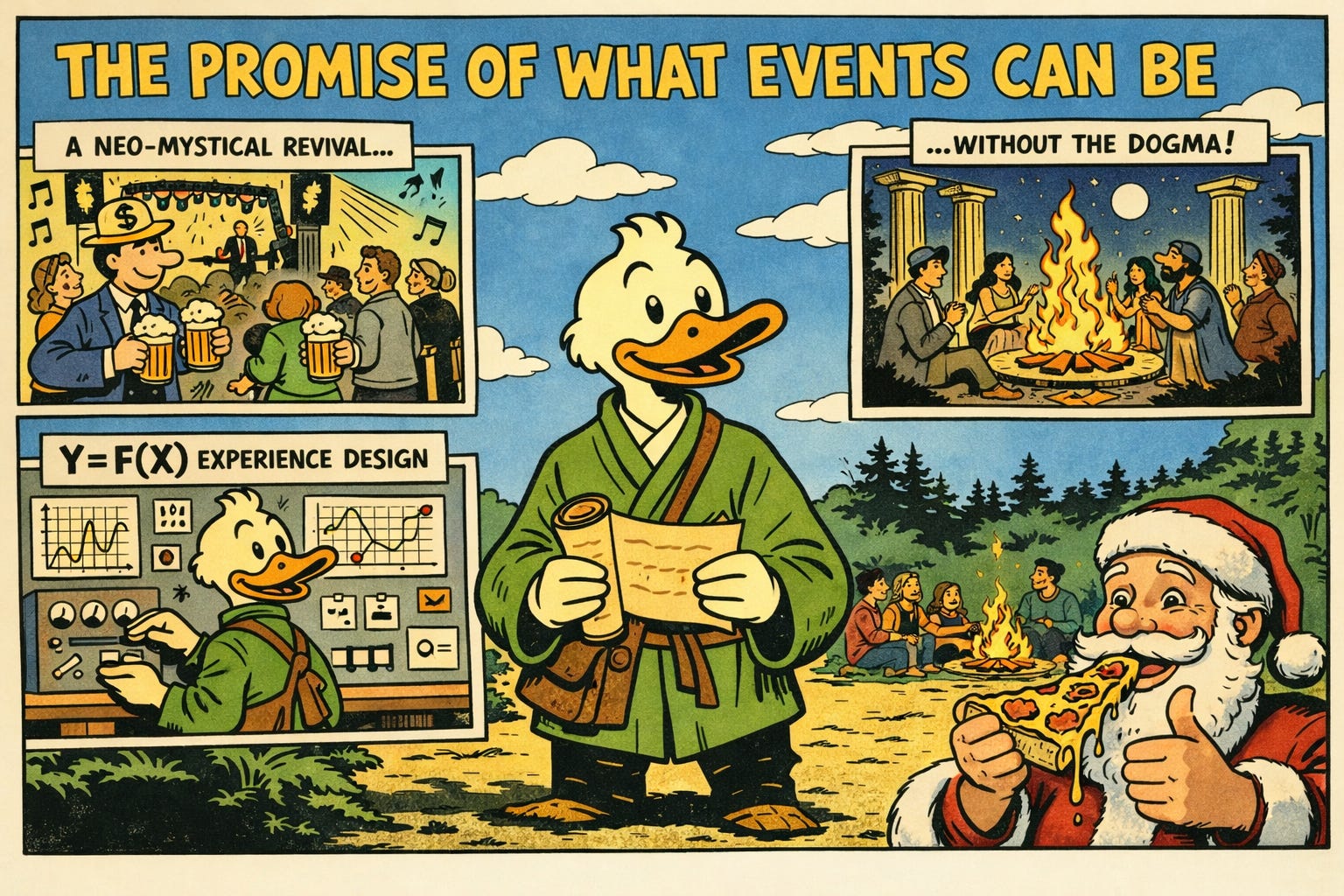
The core value proposition, as the industry sees it, is profit-maximization. How do I extract a yield? How do I get more people to buy more tickets, more beer, more whatever? The thinking is organized around talent buying, venues, and margin. It’s focused on building a better business experience when what it should be focused on is the science and art of experience design.
And the thing is, when you look at what actually differentiates one festival from another — the installations, the pop-ups, the activations — you can see a trend toward experience. People are gravitating toward it. But it remains an afterthought, a layer on top of the extraction model, rather than the core of what events actually are.
What Events Used to Be
This matters because our events used to be something else entirely.
In the ancient world, collective gatherings served as cathartic experiences that situated individuals within enormous structures of meaning-making — structures that made whole societies function. The Eleusinian Mysteries, the Dionysian festivals, the great rituals of virtually every pre-modern civilization: these were technologies for producing transformed states that embedded people in shared cosmologies, that generated the social cohesion on which everything else depended.
They weren’t solely entertainment. They weren’t purely content delivery. They were the infrastructure of meaning itself.
And what we have now, by comparison, is remarkably small in its ambitions. It helps Live Nation make billions of dollars. People are treated, if not quite like cattle, then certainly not like participants in something that could reshape how they see themselves and each other. The ambition has contracted to the point where “good vibes” is the ceiling, when it used to be the floor.
Y = F(X)
The future of events, we believe, is something that can be deliberately designed. That’s the real punchline: if you take a design mindset and think rigorously about inputs and outputs — Y = F(X) — you can start to turn knobs in ways that actually achieve goals. Not just corporate goals. Goals as individuals and as communities.
What if experiences were constructed to take individuals and communities and shepherd them toward somewhere specific? What if the “somewhere” wasn’t just “had a good time” but genuine shifts in perspective, in connection, in how people relate to each other and to the broader structures of their lives?
That whole space — the deliberate design of collective experiences for transformative outcomes — is not rigorously explored at scale. We believe it can be, and it should be.
Where Research Meets Design
This is where the argument converges with the rest of what Sensoria is building. By designing these experiences intentionally, you’re also designing containers that have the infrastructure needed for rigorous research — well-framed constructs with the variables you need to build models of how different modalities impact people’s states and wellbeing.
When we run studies “in the wild” — at retreats, at festivals, at gatherings — we need the ability to understand different correlates, to impose variables into those systems, to construct models of how music, movement, breathwork, pharmacology, social configuration, and a hundred other factors interact to produce the states we observe. Deliberately designed experiences give us that. The research and the experience design feed each other.
This is what our colleague and guest Andrés Gómez Emilsson described about our retreat in The Psychonaut Playground: the creation of containers that aren’t optimizing for depth alone (like traditional retreats), or networking (like conferences), or vibe (like festivals), but threading the needle between all three — creating the kind of setup you’d want if you were trying to actually study the phenomenology of peak experiences rather than just survive them.
The Community Imperative
There’s another dimension to this that goes beyond any single event. People like us — people who want to be part of something bigger, who are drawn to a grander mission, whether that’s consciousness research or collective flourishing or simply the desire for something more meaningful than what consumer culture offers — these people need infrastructure for gathering on a regular basis.
Underground communities already do this. Rave culture, transformational festival culture, psychedelic ceremony culture, contemplative communities — they’re already gathering, already creating spaces for experiences that go beyond entertainment. What’s missing is the infrastructure, the rigor, and the continuity that would allow these impulses to scale responsibly and produce lasting outcomes.
Providing that infrastructure — building a vessel for community that takes the best of what already exists and adds intentional design, research integration, and a genuine connection to outcomes — is something the world needs in order to achieve the kind of flourishing and social cohesion we talk about in our more ambitious moments.
A Neo-Mystical Revival, Without the Dogma
There’s one more layer to the “why” that’s worth naming explicitly, because it connects all three parts of this series.
There’s a growing sense across many circles that we need something like a neo-mystical revival. The vacuum left by the retreat of organized religion and traditional mysticism hasn’t been filled by anything nourishing. Instead, it’s been colonized by authoritarianism, by hyperconsumerism, by the weird parasitic meaning-making structures that flourish in the absence of genuine ones. People are hungry for transcendence, for awe, for experiences that situate them within something larger than themselves — and they’re getting QAnon and doomscrolling instead.
The challenge is that any revival of the mystical has to be genuinely pluralistic. It can’t be another dogma. It has to be built on the kind of ontological humility and epistemic openness that, as it happens, naturally emerge from the disciplined exploration of altered states. When you’ve experienced enough radical shifts in your own consciousness — whether through meditation, psychedelics, breathwork, or any of the many paths — you develop an almost automatic respect for the sheer diversity of possible ways to experience and interpret reality. You stop clutching your own ontology quite so tightly.
This is what we’re building toward. Not a religion, not a doctrine, but a disciplined practice of consciousness exploration embedded in rigorous science, delivered through beautifully designed collective experiences, and aimed at precisely the kind of civilizational maturation that we need. We’re trying to make civilization grow up — through a new kind of party.
It’s ambitious. It might even sound absurd. But when you look at what events once were, and what they could be again, it starts to seem less like hubris and more like remembering.
This piece is part of a series. Part I explores the neurosociology and existential risk dimensions through a conversation with co-founder Cody Gibbons. Part II makes the Galilean case for mapping the mind, by our research director Leo Christov-Moore.
Nick Synodis is co-founder of Sensoria and brings over a decade of experience in experience design, business strategy, event management, and production. Leo Christov-Moore is a senior scientist at the Institute for Advanced Consciousness Studies and leads Sensoria’s research programs.