


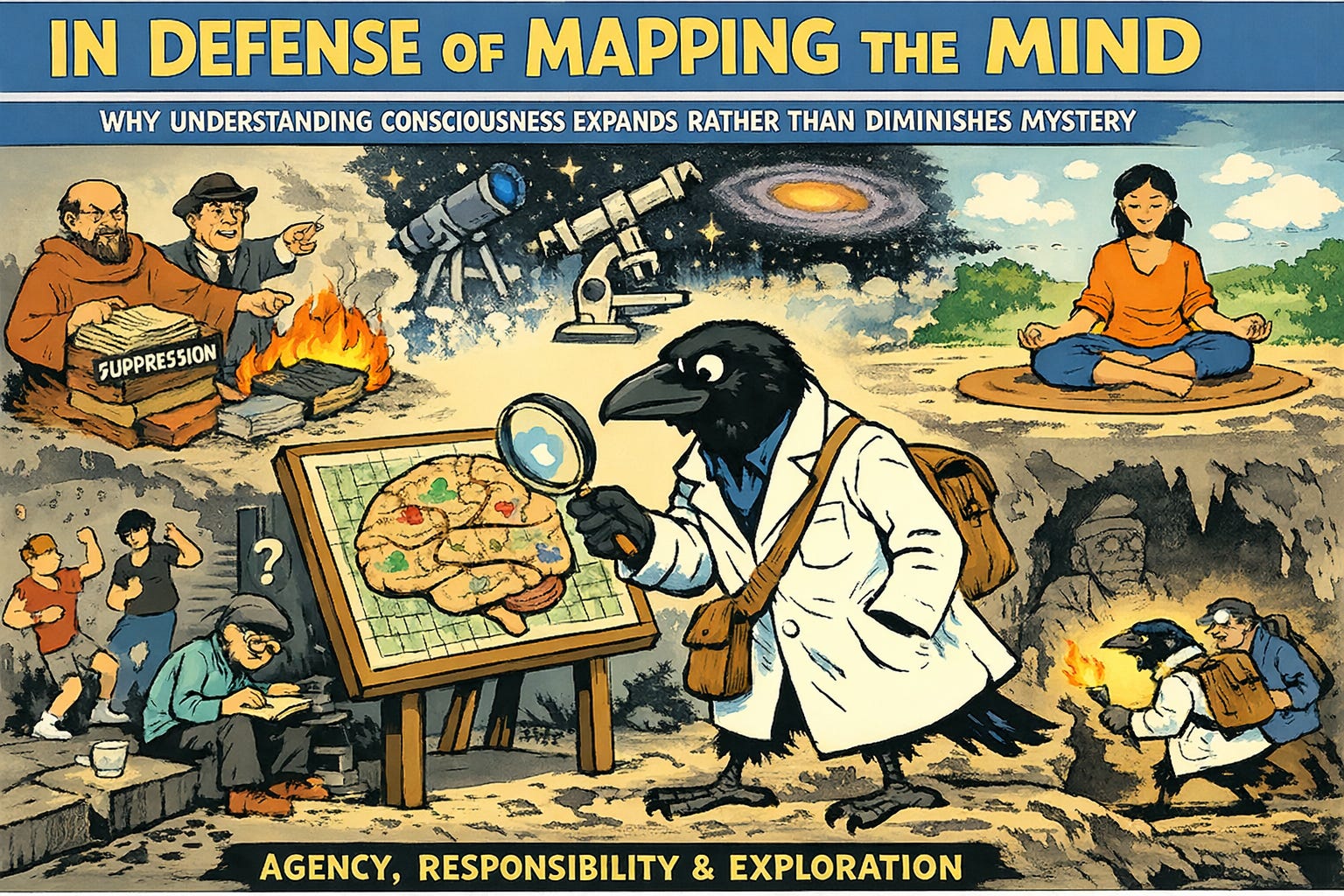
We hear certain questions repeatedly at Sensoria. Why do you want to map the mind? Doesn’t mapping the mind just help other people control it? Doesn’t this work demystify consciousness? Why are altered states important? These questions deserve serious answers, because they touch on legitimate concerns about agency, mystery, and the politics of consciousness.
But I want to gently suggest that our critics may have it backwards.
The Real Threat to Autonomy
Doesn’t mapping the mind just help other people control it?
Quite the contrary: the combination of ignorance and fear promoted by institutional mediators in service of controlling power—via the suppression of mysticism, the suppression of psychedelic practices throughout history, the suppression of even esoteric and non-esoteric studies of the mind—is precisely what we are trying to fight against.
The true danger to mental autonomy isn’t greater understanding. It’s obscurantism deliberately maintained by those who benefit, knowingly or unknowingly, from it.
Think about what catalyzed revolutions within religions and political systems: the printing press, the cafe, widespread literacy, that allowed people to “do their own research” and study the universe, God, on their own terms, and share their insights with others. When people could access and discuss sacred texts without priestly intermediation, power structures built on exclusive knowledge began to crumble.
We’re already seeing the democratization of altered state exploration happen. We are increasingly able to access democratized meditation practices, breathwork, and yes, psychedelics. But it shouldn’t just be isolated artists and poets and scientists doing this via trial and error, the way world-mapping once used to be. It’s something that everyone should have the agency and ability to do, with proper preparation and support.
Freedom Through Responsibility
This “do your own research” framing might suggest that we’re advocating for some kind of free-for-all, where everyone wings it without guidance or standards.
Nothing could be further from the truth.
Right now, most people are passive passengers navigating mental state space—tossed about by mental illness, manipulation, unconscious patterns, and forces they don’t understand. Our goal is to help people develop the agency to understand the space and explore it on their own terms, with safe guides and tools.
We do not suggest that we think there shouldn’t be standards, methods, harm reduction, expertise, certifications, tools. Quite the contrary. While we advocate for more openness, transparency, and autonomy, we also advocate for greater levels of responsibility, education, and training. In fact, we’re collaborating with other members of the Neurophenomenology Consortium to build psychonaut certifications, navigation tools, and state space maps.
We think everyone should be free to fly, but we want to make sure they get licensed, so we don’t have people whooping around the sky and getting into accidents that harm themselves and others.
We are not advocating for an abrogation of expertise. The urgency of the polycrisis—the mental health issues facing our civilization—combined with the real danger posed by untutored, marginalized explorations of the mind that often occur in alleyways and after raves, demands that we undertake this exploration in a mature fashion. One that is clear-eyed about the risks, but also mature about the possibilities of unseen benefits. One that leans into a worldview based on agency and responsibility.
Mystery Expands, Not Contracts
Doesn’t this work demystify consciousness?
I don’t think affording people tools and a sense of there being a space to explore diminishes mystery. When we built telescopes to see distant galaxies, when we developed microscopes to reveal microscopic worlds, did we diminish mystery? On the contrary—we discovered entire universes of complexity we never knew existed. The picture of the world became vaster, and more complicated. Not a single new, high-definition image comes out of the brain, or our galaxy, with the headline “PROBLEM SOLVED - NOTHING TO SEE HERE.” Virtually every time the caption is “New microscope/technique reveals UNSEEN features of the natural world.” Historically, those who try to reduce the complexity of our models - insisting on one sexuality, one god, one center of the universe, or one economic model, are rarely acting in the service of general liberation or empowerment, and are usually serving fear, division, and the domination of others.
We have so much more to discover about the possibilities of the human mind; and about our capabilities to heal ourselves. We still lack general, even rudimentary means to help plumb the chaotic depths of our unconscious in ways that allow people to bring back knowledge and inspiration useful to them.
The more we understand about the varieties of consciousness, the more we see all the spaces of unknown rather than only those initially visible within a single frame of mind. You can come to revere mental state space as a traveler and as an explorer, rather than as a passive passenger on the boat of emotions, insecurities, and neuroses.
The Sobriety Illusion
What we generally perceive as our “sober” resting state might not be the most conducive state for most of the outputs we would like in our lives. There’s an implicit, largely unexamined view of the term sobriety, as if it does not itself entail a largely uncontrolled state space navigation.
Even on a given day, people traverse many moods, attentional states, drive states. Much of what people are doing—particularly if they’re not trained in meditation or haven’t had significant amounts of therapy—is navigating states all the time. They just don’t know where they are, they don’t know how they got there, and they don’t know how to get where they want to go.
We’re all navigating state space whether we like it or not. It’s just a matter of: Do you know how to get where you want to go? Do you know where you are? Do you know how to get back to a place you happened to find by accident?
The fact that we’re wandering blind is absurd in this day and age. It’s as if we accepted not having maps of the world. Imagine going to an amusement park, your favorite place you’ve ever been to, and never finding it again because there are no maps, no gps, no guides—you have to ask the one guy who knows, and you better hope he’s home, and you’d better pay him.
That’s not how we do geographical navigation. Why do we accept that for psychological navigation, the traversal of our own mind? We don’t own the world, and yet we can feasibly claim to know how to get anywhere on it. Our mind belongs to us, ostensibly, and we don’t know how to navigate it. In fact, many existing methods are hidden or illegal. That’s absurd.
Against Escapism: Toward a Neo-Mysticism
There is no escaping consciousness. There is no escaping the mystery of being alive, and the suffering and impermanence inherent to life. And specifically to that point, we think the use of drugs to escape rather than to explore is right away the wrong approach, even if it’s one we understand and have compassion for.
We encourage not intoxication but alteration in order to understand the varieties and the shape of the space of one’s consciousness. So that no part of it is considered purely a dangerous land, but additionally a place that one can explore in order to better know oneself, and become a better explorer (for the dangerous parts).
Ultimately, in promoting a personal relationship with the mystery of consciousness in the service of collective meaning-making, we support a kind of pluralistic revival of mysticism. Like societies confronted with mysticism throughout history, however, we often do not explore these deeper spaces of our minds because of (understandable) fear of what we might find. These are deep waters. And not everyone is as courageous as the mystics. But those who aspire to their example should have help. They should have maps. They should have guides. They should have training.
So why are you doing all of this?
This work is born out of the same impulses that guide any form of therapy, and any form of exploration. Like all of those, it can produce new monsters, but also new tools against them. The alternative is continued obscurantism and suppression of people’s bodily and mental autonomy, which typically serves the interests of those who exert that suppression and that censorship.
At Sensoria, we believe people deserve maps. They deserve to understand that there is space to explore. And they deserve the tools, frameworks, training, and responsible guidance to explore it safely, intentionally, and on their own terms.
This is Part 2 of a three-part series on the Sensoria mission.